During these days, the sun is at its strongest, the water is most healing, the herbs are most medicinal, and magic is most powerful.
The Midsummer Day celebrations at the Etar Museum begin today, June 21, and continue until June 24.
Midsummer Day is the biggest summer holiday, and on the days around it, the sun is at its strongest, water is at its most healing, herbs are at their most medicinal, and magic is at its most powerful.
The holiday dates back to ancient times and is associated with ancient sun cults from our pagan past. In traditional beliefs, Enio is a mythical character identified with the sun, and in the Christian religion, the day is associated with the birth of St. John the Baptist.
The days around Midsummer Day are the longest of the year, and the nights are the shortest. And it is precisely the night before Midsummer Day that is filled with mysticism and mystery. This is the night of the mamniki – sorcerers who go out into the fields to steal other people’s crops. They strip naked or wear only a white shirt, ride a loom from a loom, or drag an apron behind them, in which they collect dew and knead it into bread. They put it in their barn, believing that the fertility will be transferred to their fields.
On the night before Midsummer’s Day, blue flames flash in some places to show where treasure is buried, and the stars descend to earth and “bless” the herbs to make them more healing.
Our ancestors believed that on the morning of Midsummer Day, the sun rises early, rests before its long journey, bathes in living water, and, thus rejuvenated, turns back to head toward winter. That is why everyone hurried to bathe in the water where the sun had bathed before, or to roll around in the healing morning dew for good health.
At dawn, before sunrise, women (herbalists, fortune tellers, sorcerers) pick herbs, believing that they are most healing at that time. Herbs are also picked on St. George’s Day, St. Jeremiah’s Day (May 1) and Spasovden, but on Midsummer Day, as the founder of Bulgarian ethnography Dimitar Marinov points out in his study “Folk Beliefs and Religious Folk Customs,” “herb gathering is a ritual and widespread practice.”
According to popular belief, there are seventy-seven and a half diseases, and there is a herb for each of them. Only on the night before Midsummer’s Day can the half herb be found, which is for the unknown disease.
Ethnographer Dr. Angel Goev, in his publication “Calendar Customs of the Balkan People,” points out an interesting way to find the half herb. For this purpose, the fortune tellers enclose a small area on the meadow, into which they release a turtle. The herb that the turtle bites is determined to be the unknown herb that has the ability to dissolve any closed space. It is also called the herb of love and can dissolve any heart. It is highly sought after by young women to perform love spells on young men.
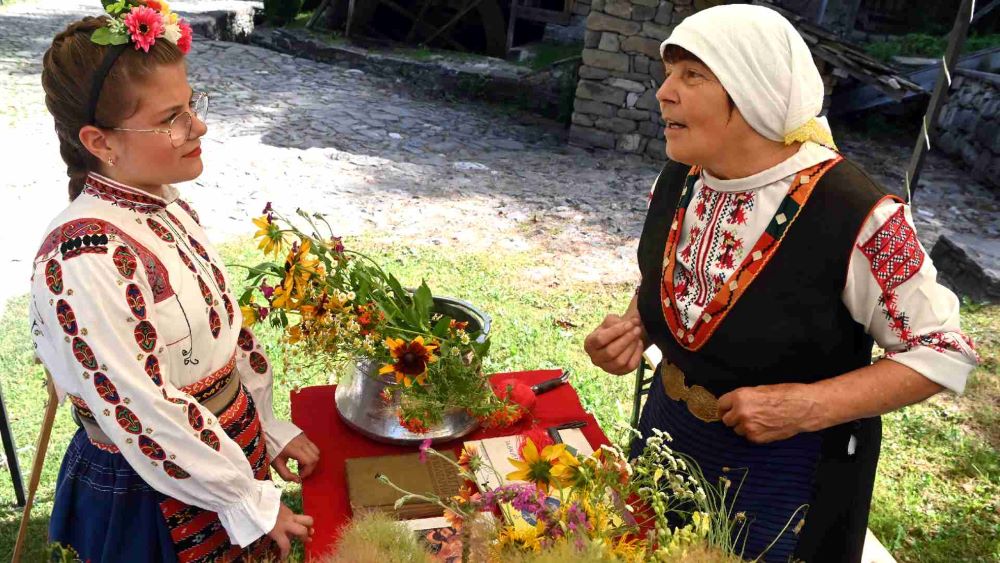
There are seven herbs that young women use to make bouquets on Midsummer Day: white yarrow, peony, mother-of-pearl, marigold, geranium, rose, and basil. To make the young men love them, the girls “reinforce” the bouquet with love herbs – sweet woodruff, sticky herb, lovage, and lovage. If a girl puts a bouquet of white yarrow in her bosom and sleeps with it, she will marry the young man she dreams of.
The herbs are also used to weave a wreath, through which girls, brides, and women pass for good health. The wreath is circular in shape, which gives it protective powers, and the bouquets of herbs gathered on Midsummer Day are dried and used for medicinal purposes throughout the year.
Come to the Midsummer Day celebrations at the Etar Museum from June 21 to 24 to make a bouquet for good health in a workshop for making bouquets!
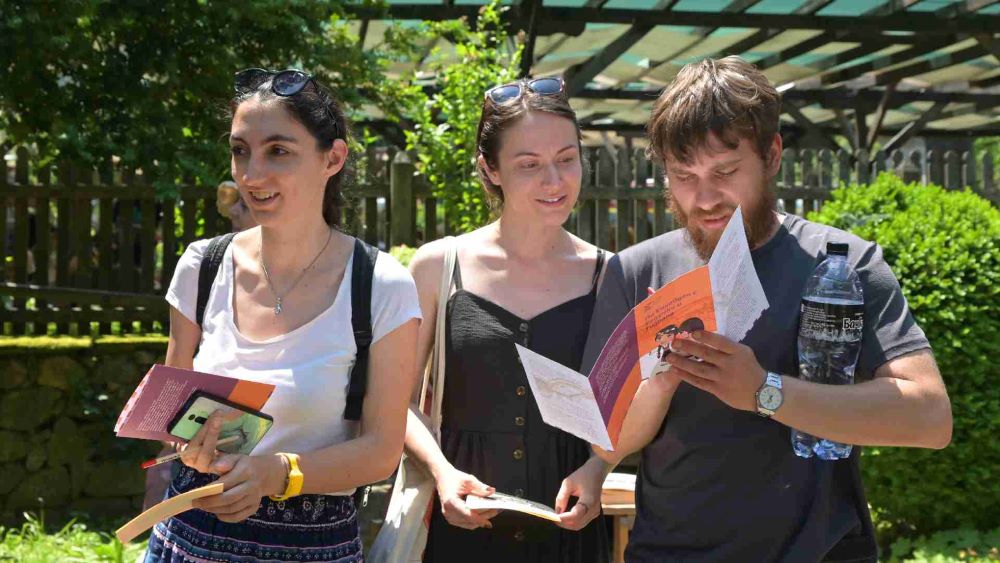
Take part in our educational family game “Midsummer Day with Radumko and Gizdana” to learn more about the festive rituals of Midsummer Day and the use of herbs in the past and today! Prizes await you at the end of the game!